
We Heal Better Together
What losing my mother—and decades of research—taught me about the power of reaching out

When my mom turned 50, she scheduled a grand trip to celebrate this momentous birthday. Six of us — my mom and her husband (my step-father), her mother, my brother, plus me and my husband — flew to Greece and then spent 10 days cruising the Mediterranean sea.
The ports of call were of course amazing: Athens, Santorini, Jerusalem, Alexandria, Cyprus. But what I remember most about that trip was the time we spent together on the ship: eating long leisurely dinners, sitting by the pool, walking laps around the pool deck.
When the trip ended, we remarked on how difficult it was going to be to top this experience when she celebrated 60.
Today my mom should be turning 79, and we should be starting to plan a giant party or trip to celebrate her 80th. We never had the opportunity to celebrate her 70th or even her 60th. She died two days after turning 57, meaning I’m now older than she ever was.
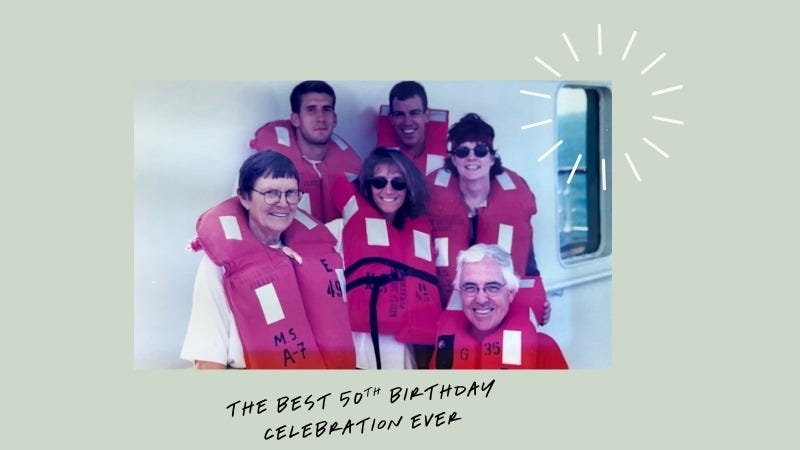
I’ve thought a lot about this trip over the past few weeks as her birthday approached. But I’ve also thought a lot about what happened after she died—and what helped me slowly find my footing again. Because while grief is deeply personal, one of the strongest findings in psychology is that we don’t heal from it alone.
One of the challenges people face following a great loss is feeling isolated and alone in their grief, which is one reason why support groups are often so valuable. People who make connections with others, especially those who understand the nature of their grief, find it easier to cope and eventually experience happiness again.
Researchers in one study randomly assigned bereaved people to receive either 3 months of individual therapy or group therapy. Although both types of therapy led to reductions in grief severity over time, group therapy was particularly helpful for people experiencing the highest levels of distress.
One of the most remarkable demonstrations of the power of social support in helping people manage grief comes from a study of college students who survived the 2007 mass shooting at Virginia Tech, in which thirty-three people died.
As you might expect, some students showed higher levels of depression and anxiety over the next year. Other students didn’t show a big change in their overall mood state, for better or for worse.
But the most remarkable finding was that some students actually felt better in the year after experiencing this tragedy. In fact, students who sought out social support from and developed stronger connections with other students showed decreases in anxiety and depression. Thus, even in the case of truly catastrophic events, building connections makes people feel better.
But connection doesn’t only come through formal support groups or major acts of kindness. Sometimes it comes through the smallest gestures—the ones that tell us we are not alone and that the people we love are not forgotten.
My mom died more than twenty years ago, but I still appreciate the people who help keep her memory alive. Her best friend reaches out every year on my mom’s birthday just to check in (she’s the only person who still calls me “baby girl”). Her oldest brother sends a photo to our family email every year to commemorate the day. And my brother always texts me to say his family has just gone to Dairy Queen—one of my mom’s favorite treats—in her honor.
None of these gestures changes the fact that she’s gone. But every one of them reminds me that someone else remembers her, too. And that’s exactly what the research tells us: feeling connected to other people doesn’t erase grief, but it makes it easier to carry.
So here’s my question for you: What’s one small gesture someone made—or continues to make—after you lost someone you loved that has stayed with you over the years?

So sad to lose a parent at age 57 and celebrating her on her birthday is a beautiful way to honor her. I’m always very touched when my brother’s high school friends reach out to me to commemorate his birthday. Loss shared does seem to lighten the load. For my bother’s and my parents’ birthdays, I light a special candle and try to have their favorite meal for dinner. It’s my way of letting them know I still miss them.
Your message this week is so important - and a reminder to not forget people who have suffered a significant loss. We’re all busy people - and after the funeral is over, we tend to get back to our own lives. Thank you for your weekly insights.